
But there is another number I believe deserves just as much attention:
Your VO₂ max.
VO₂ max is one of the best objective measurements we have of cardiorespiratory fitness—how effectively your heart, lungs, blood vessels, and muscles work together to deliver and use oxygen when your body is challenged.
And this is about much more than athletic performance.
Cardiorespiratory fitness is strongly associated with cardiovascular health, chronic disease, functional independence, and longevity. In fact, the American Heart Association has advocated for cardiorespiratory fitness to be considered a clinical vital sign, citing evidence that it may be an even stronger predictor of mortality than several traditional risk factors.
That is why I care so much about measuring it.
At Forbes Longevity Center, VO₂ max testing isn’t something we reserve for elite athletes. It is an important part of understanding how well your body is functioning today—and how much physical reserve you are carrying with you into the decades ahead.
And perhaps most importantly, fitness is something we can change.
What Exactly Is VO₂ Max?
Every cell in your body needs oxygen.
Your lungs bring oxygen into your body. Your heart pumps oxygen-rich blood. Your blood vessels deliver it. And your muscles use that oxygen to produce energy.
When you are sitting quietly, the demand is relatively low.
Start walking uphill, climbing stairs, riding a bike, or exercising intensely and suddenly your body needs much more oxygen. Your heart, lungs, circulation, and muscles all have to respond.
VO₂ max measures the maximum amount of oxygen your body can use during strenuous exercise.
Think of it as the capacity of your body’s aerobic engine.
The larger and more efficient that engine is, the greater your cardiorespiratory fitness and physical reserve.
Why VO₂ Max Matters So Much for Longevity
This is where the data become difficult to ignore.
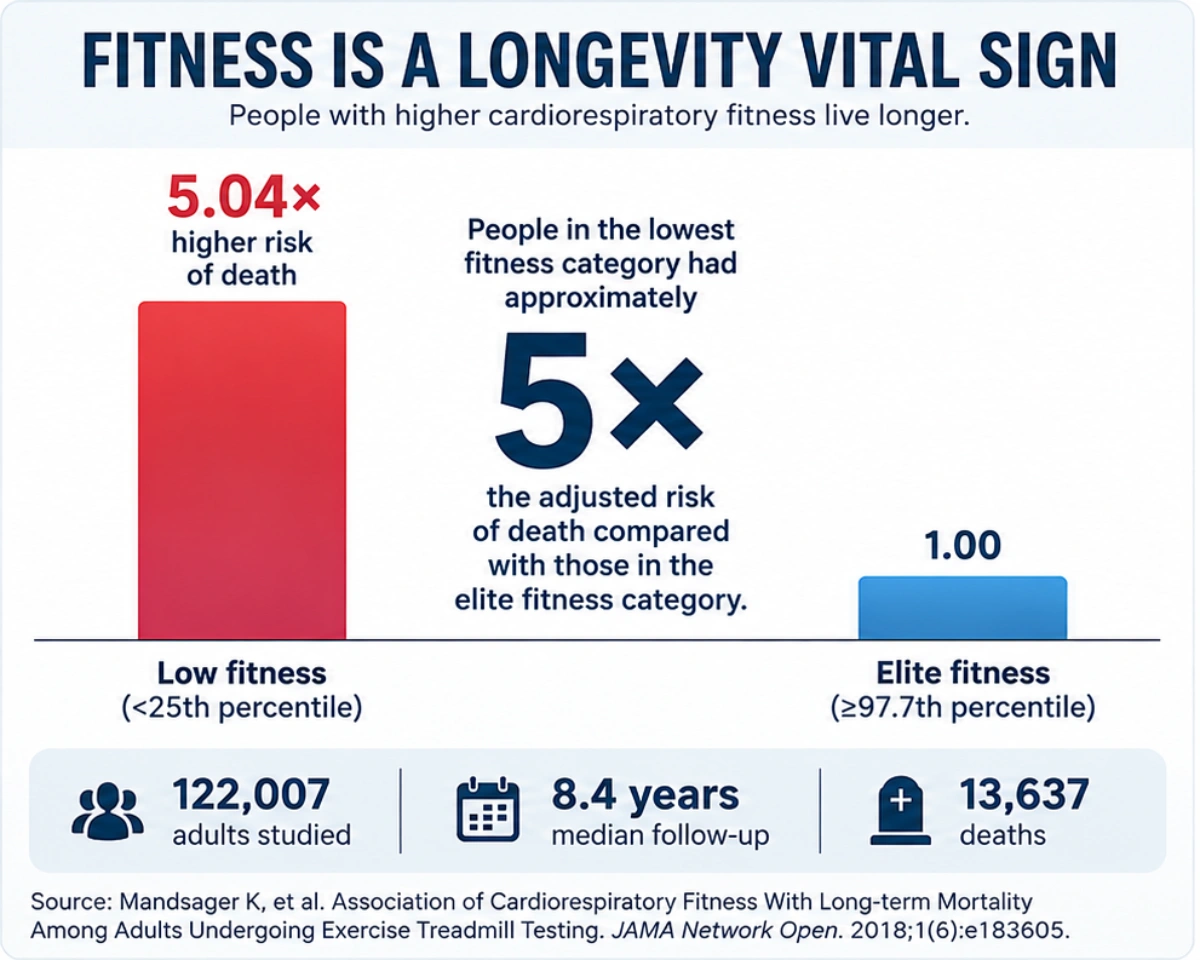
One of the largest studies examining fitness and longevity followed 122,007 adults who underwent exercise treadmill testing at Cleveland Clinic.
Researchers divided participants into age- and sex-adjusted fitness categories ranging from low fitness to elite fitness.
The difference was remarkable.
People in the lowest fitness category had approximately 5 times the adjusted risk of death compared with those in the elite fitness category.
Even the difference between being below average and above average mattered: those with below-average fitness had a 41% higher adjusted mortality risk than those with above-average fitness.
The researchers found no observed upper limit beyond which greater fitness stopped being associated with benefit.
Even more striking, the mortality risk associated with poor fitness compared with elite fitness was greater than the associations seen with several traditional cardiovascular risk factors in the study.
This doesn’t mean VO₂ max determines how long you will live. These are observational data, and many factors influence longevity.
But they reinforce an important point:
Fitness is not simply about performance. Fitness is a powerful marker of health.
Your Fitness Today May Help Shape Your Health Decades from Now
Newer research makes this conversation even more interesting.
A 2026 study published in the Journal of the American College of Cardiology followed 24,576 adults from the Cooper Center Longitudinal Study and examined the relationship between cardiorespiratory fitness in midlife and health later in life.
Those with greater midlife fitness experienced a lower burden of chronic disease and longer health span and lifespan.
Perhaps one of the most meaningful findings was that the onset of major chronic diseases occurred later among people with high fitness.
This is exactly what longevity medicine should be about.
I don’t simply want my patients to live longer.
I want to delay the years dominated by disease and preserve the years in which they are healthy, strong, independent, and enjoying their lives.
Fitness Still Matters After 65
Sometimes patients tell me, “Well, I’m already 65 or 70. How much difference can changing my fitness really make now?”
The answer is: fitness still matters.
An August 2026 JAMA Network Open study evaluated 13,423 adults age 65 and older and objectively measured several components of physical fitness.
Higher fitness was associated with progressively lower all-cause mortality.
For cardiorespiratory fitness specifically, participants in the highest-performing group on a 2-minute step test had a 42% lower adjusted mortality risk compared with those in the lowest-performing group.
And fitness was about more than cardiovascular capacity. Balance and agility, lower-body strength, and overall physical fitness were also strongly associated with mortality.
That reinforces something we emphasize constantly at Forbes Longevity Center:
Longevity requires both cardiovascular fitness and strength.
We need the engine.
But we also need the muscle, balance, mobility, and physical capability to use it.
Think of VO₂ Max as Your Physical Reserve
This may be the most important concept to understand.
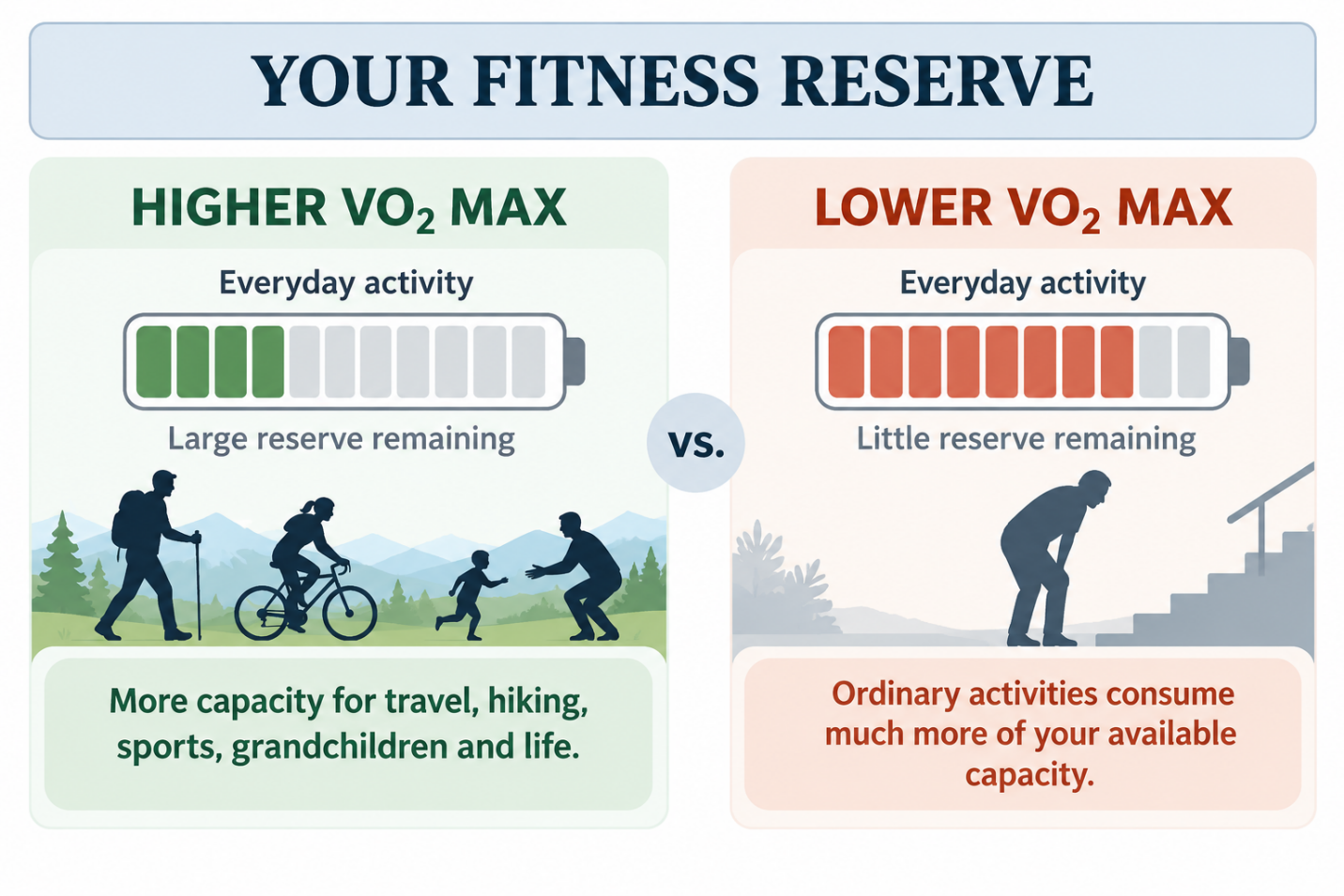
Imagine that climbing a flight of stairs requires a certain amount of energy.
When you are highly fit, climbing those stairs may require only a small percentage of your maximum capacity.
You have plenty left in reserve.
As VO₂ max and physical fitness decline with age, that same flight of stairs represents a greater percentage of your total capacity.
Eventually, everyday activities can begin to approach your maximum.
The stairs become difficult.
Walking through an airport becomes exhausting.
Carrying luggage becomes challenging.
The hike on vacation becomes something everyone else does while you stay behind.
This is why I don’t think about VO₂ max simply in terms of exercise.
I think about it as your physical freedom.
What Is a Good VO₂ Max for Your Age?
There isn’t one perfect VO₂ max number for everyone.
VO₂ max varies by age and sex, and it is influenced by genetics, medications, medical conditions, exercise history, and current fitness.
That is why I don’t like looking at the number in isolation.
We want to know where you fall compared with appropriate age- and sex-based reference values and what that means in the context of your overall health.
But I also don’t believe that “average for my age” should automatically be our goal.
If our goal is longevity, we want to preserve as much cardiovascular and physical capacity as reasonably possible.
Aging is associated with a decline in cardiorespiratory fitness.
That doesn’t mean we should passively accept it.
What Happens During a VO₂ Max Test?
Clinical VO₂ max testing is very different from simply seeing how long you can stay on a treadmill.
During testing, you exercise on a treadmill or stationary bicycle while wearing specialized equipment that measures the oxygen you consume and carbon dioxide you produce.
The workload progressively increases as we evaluate how your body responds to increasing physical demand.
Rather than estimating your fitness based solely on how fast you walked or how long you exercised, we can objectively measure your aerobic capacity.
At Forbes Longevity Center, we interpret VO₂ max as part of a much broader assessment.
We look at your cardiovascular health, body composition, muscle mass, visceral fat, metabolic health, vascular health, exercise habits, and other health data.
The question isn’t simply:
“Do you exercise?”
I want to know:
How fit are you today? How fit could you be? And what do we need to do to get you there?
My Watch Gives Me a VO₂ Max. Isn’t That Enough?
I love that wearables have made people interested in VO₂ max.
Depending on the device, your watch may estimate VO₂ max using information such as heart rate, pace, age, sex, and exercise data.
That information can be extremely useful for following trends over time.
But it is still an estimate.
Clinical VO₂ max testing directly measures respiratory gases during a graded exercise test, providing a more objective assessment of aerobic capacity.
I actually like having both.
Your wearable gives us longitudinal information about what is happening in your everyday life.
Clinical testing gives us a standardized measurement that we can integrate with the rest of your health assessment.
Can You Improve Your VO₂ Max?
Yes—and this is one of the reasons I love measuring it.
You can’t change your chronological age.
You can’t choose different parents.
You can’t rewrite all of your genetics.
But you can train your cardiovascular system.
For many patients, I recommend combining two different types of aerobic training:
Zone 2 training helps build your aerobic foundation and improves your body’s ability to efficiently produce energy over longer periods.
High-intensity interval training (HIIT) challenges the upper limits of the cardiovascular system and can be particularly helpful for improving VO₂ max.
For HIIT, that may mean short intervals of approximately 20–60 seconds of higher-intensity work followed by recovery, individualized to the person’s fitness and health.
Not everyone should begin at the same intensity.
A 40-year-old athlete and a sedentary 72-year-old shouldn’t receive identical exercise prescriptions.
That is exactly why testing is valuable.
Instead of telling everyone to simply “exercise more,” we can measure where you are starting and create a more intentional plan.
And then we can measure again.
Because what gets measured can be improved.
VO₂ Max Is Only One Part of Fitness
As important as VO₂ max is, cardiovascular fitness alone is not enough.
The 2026 study of adults over 65 reinforces something I strongly believe: we need to train for the entire lifespan.
That means maintaining:
- Cardiorespiratory fitness
- Muscle mass and strength
- Balance
- Mobility and flexibility
- Metabolic health
- Healthy body composition
This is why our fitness assessment at Forbes Longevity Center goes beyond simply putting someone on a treadmill.
We assess aerobic capacity and VO₂ max along with muscle mass, visceral fat, body composition, and biologic fitness age, then use those findings to help develop an individualized exercise strategy.
Don’t Just Add Years to Your Life. Build the Capacity to Live Them.
Longevity medicine should not simply be about finding disease earlier.
Of course I want to know your blood pressure.
I want to know your cholesterol and ApoB.
I want to understand your blood sugar and insulin sensitivity.
I want to know whether cardiovascular plaque is developing years before it causes symptoms.
But I also want to know something that traditional medicine often doesn’t measure:
Is your body physically capable of supporting the life you want to live 10, 20, or 30 years from now?
Will you have the cardiovascular capacity to travel?
Will you have enough muscle to remain independent?
Will you be able to hike, ski, play golf, carry your own luggage, get up from the floor, and keep up with your grandchildren?
That is what fitness means to me.
VO₂ max gives us an objective measurement of one of the most important pieces of that equation.
It tells us where your cardiorespiratory fitness is today.
It gives us something we can work to improve.
And it gives us something we can fight to preserve as you age.
The goal isn’t simply to live longer.
The goal is to have the strength, fitness, health, and physical freedom to truly live those years.
That is why VO₂ max testing is such an important part of the longevity evaluation at Forbes Longevity Center.
References
Ross R, et al. Importance of Assessing Cardiorespiratory Fitness in Clinical Practice: A Case for Fitness as a Clinical Vital Sign. Circulation. 2016;134.
Mandsager K, et al. Association of Cardiorespiratory Fitness With Long-term Mortality Among Adults Undergoing Exercise Treadmill Testing. JAMA Network Open. 2018;1(6).
Meernik C, et al. Midlife Cardiorespiratory Fitness and Healthy Aging: An Observational Cohort Study. Journal of the American College of Cardiology. 2026;88(3).
Wu M, et al. Physical Fitness and All-Cause Mortality in Older Adults. JAMA Network Open. 2026;9(8).